Affordable CCTV Systems for Business What's the Minimum You Should Spend?
By Admin
22 Apr 2026
Whether you run a small retail shop or manage a multi-floor office, CCTV systems for business are no longer optional. They are a fundamental part of running a secure, accountable, and well-managed operation.
But here's the question most business owners Google before doing anything: How much do I actually need to spend?
This blog breaks it all down. From camera types and placement to costs and what to realistically expect in Pakistan's market, this is the only guide you need before installing CCTV cameras for your business.
Table of Contents
- Why Does Your Business Need CCTV?
- IP Camera vs Analog Camera for Office Which Should You Choose?
- How Many CCTV Cameras Does a Business Need?
- CCTV Camera Placement Guide Get This Right First
- What Does a Business CCTV Setup Cost in Pakistan?
- What is the Best CCTV Brand for Small Business?
- What Is the Minimum You Should Actually Spend?
- Conclusion
- Frequently Asked Questions
Why Does Your Business Need CCTV?
Many business owners delay getting CCTV because they think it's either too expensive or unnecessary until something goes wrong. Here's why that mindset is costly:
- Theft and shrinkage: Internal theft is one of the leading causes of business losses globally. Cameras on the floor and stockroom significantly reduce this.
- Liability protection: In case of accidents, disputes, or false claims, CCTV footage is your most reliable evidence.
- Employee accountability: Camera presence increases workplace discipline without micromanagement.
- Remote monitoring: Modern systems let you watch your business from your phone, anywhere, at any time.
- Crime deterrence: Visible cameras reduce the likelihood of break-ins and unauthorized access. They are a core part of any complete security solutions strategy.
A single incident without recorded proof can cost far more than an entire CCTV setup. Think of it as insurance you can also see.
IP Camera vs Analog Camera Which Should You Choose?
This is one of the most common questions, and the answer depends on your budget and needs.
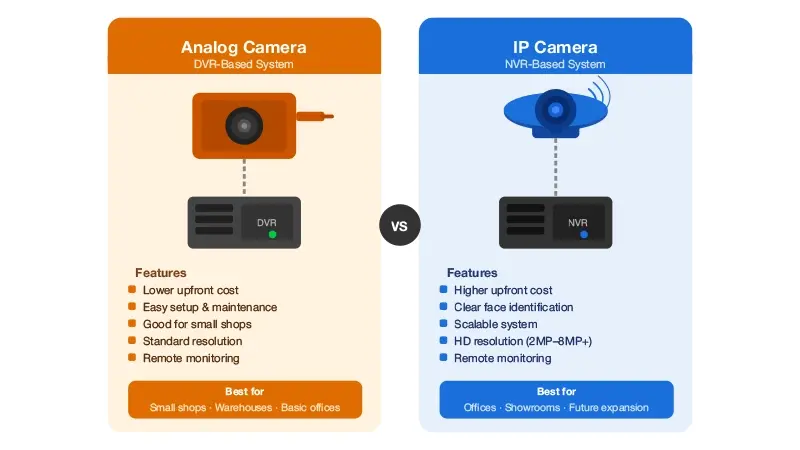
Analog Cameras (DVR-Based)
- Lower upfront commercial surveillance camera cost
- Available in resolutions from 2MP to 4MP with select models supporting 4K
- Support remote monitoring
- Easier to set up and maintain
- Good for small shops, warehouses, and basic office environments
- Record footage to a DVR (Digital Video Recorder)
IP Cameras (NVR-Based)
- Higher image resolution (2MP to 8MP and beyond)
- Support remote monitoring via smartphone apps
- Scalable without replacing your whole system
- Record to an NVR (Network Video Recorder)
- Ideal for setups requiring clear face identification or future expansion
For a small setup with 4 to 8 cameras, analog does the job. For high-detail footage, or long-term scalability, go IP.
How Many CCTV Cameras Does a Business Need?
There is no fixed number, but here is a reliable starting point:
- Small shop or cafe: 2 to 4 cameras
- Medium office (50+ employees): 6 to 12 cameras
- Warehouse or factory floor: 12 to 24 cameras
- Large commercial complex: 24+ cameras
Key areas to always cover:
- Main entrance and exit points, ideally paired with access control solutions for complete entry management
- Cash counters and POS areas
- Parking lots and loading bays
- Server rooms and sensitive storage
- Staircases, corridors, and blind spots
Start by mapping your floor plan and identifying high-risk zones. That determines your camera count, not guesswork.
CCTV Camera Placement Guide Get This Right First
Even the best cameras will fail you if placed incorrectly. These are the principles that matter:
1. Cover all entry and exit points first. Every door, gate, and window that provides access to your premises should be monitored.
2. Angle matters more than quantity. One well-placed camera can cover what two poorly placed ones cannot. Aim for 15 to 30 degrees below ceiling level for optimal coverage.
3. Avoid direct light and glare. Cameras pointed at windows or light sources produce washed-out footage. Position them with light behind the subject, not behind the camera.
4. Mix dome and bullet cameras. Dome cameras work indoors for wide-angle coverage. Bullet cameras handle outdoor conditions better due to weatherproofing and longer range.
5. Use night vision cameras for entrances and parking areas. Outdoor spots need IR night vision security cameras to maintain clear footage in low or zero light.
What Does a Business CCTV Setup Cost in Pakistan?
Here is a realistic breakdown for a complete business CCTV setup in Pakistan:
Entry-Level Setup (4 cameras, DVR, standard resolution, remote monitoring) – PKR 25,000 to PKR 45,000. Best for small shops, retail counters, or single-floor offices.
Mid-Range Setup (8 cameras, NVR, HD resolution, remote monitoring) – PKR 60,000 to PKR 120,000. Suitable for medium offices, restaurants, and showrooms.
Professional/Industrial Setup (16+ cameras, IP-based, 4K, full remote monitoring) – PKR 150,000 and above. For factories, warehouses, corporate buildings, and multi-branch setups.
What the total CCTV installation cost in Pakistan typically includes:
- Camera units
- DVR or NVR system
- Hard drive for storage
- Cables, connectors, and power supplies
- Labor charges for installation and configuration
- Mobile app setup for remote access
Do not just budget for cameras. Poor storage means losing critical footage exactly when you need it most.
What Is the Best CCTV Brand for Small Business?
In Pakistan's commercial market, two brands consistently lead:
Hikvision: The most widely deployed brand globally. Covers everything from basic analog setups to high-end IP systems. Strong night vision, reliable remote access, and proven durability make it the go-to for businesses of all sizes.
Dahua: A close competitor with comparable specs at competitive price points. Widely installed across commercial and industrial setups in Pakistan.
For most small businesses, Hikvision's mid-range lineup gives the best balance of cost, quality, and long-term reliability.
What Is the Minimum You Should Actually Spend?
Do not go below PKR 25,000 to 30,000 for a complete system including installation.
Anything less usually means:
- Cameras too low-resolution to identify faces
- No adequate DVR/NVR storage
- No night vision
- No remote monitoring support
Cutting corners on CCTV is one of the most expensive mistakes a business can make. A properly installed 4-camera HD system in the PKR 30,000 to 45,000 range is the realistic, reliable entry point for any business in Pakistan.
Conclusion
CCTV is not a luxury. For any business serious about security, accountability, and loss prevention, it is a basic operational requirement. The good news is that a well-planned system does not have to break the bank. What matters more than budget is getting the right cameras in the right places, backed by a proper recording setup.
If you want a system that is built to last and not just installed and forgotten, working with an experienced provider makes all the difference. Horizon Technologies has spent over 20 years designing and deploying surveillance solutions across Karachi, from single-shop setups to large-scale industrial deployments. They can assess your space, recommend the right system, and handle everything from installation to ongoing maintenance under a structured CCTV maintenance contract.
We hope this guide has answered most of your questions about what to consider when installing a CCTV system for your business. If you still have questions or need a professional assessment, we are just a call away.
Frequently Asked Questions
Q1: How many CCTV cameras does a small business need?
Most small businesses need 2 to 6 cameras covering entry points, cash areas, and blind spots.
Q2: What is the average CCTV installation cost in Pakistan for a small office?
A basic 4-camera setup with DVR and installation typically runs between PKR 25,000 and PKR 50,000.
Q3: What is the difference between IP and analog cameras for business?
Analog is affordable and simpler and offers remote monitoring. IP offers higher resolution, remote access, and better scalability.
Q4: Can I monitor my business CCTV remotely from my phone?
Yes, both analog DVR and IP NVR-based systems support live remote viewing through a smartphone app.
Q5: What is the best CCTV brand for a small business in Pakistan?
Hikvision and Dahua are the top choices; Hikvision is most widely used due to its reliability and range.
